
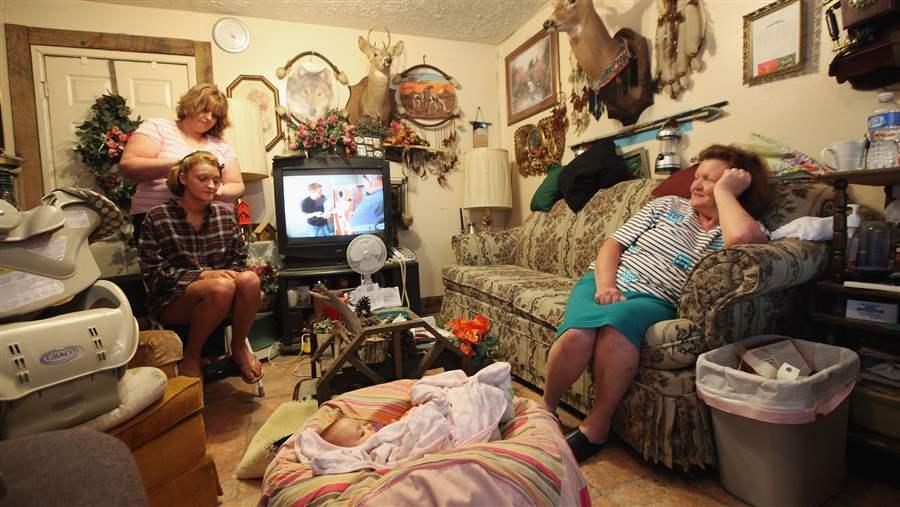
Due to steadily-growing handouts by the government to the “poor,” people in the bottom fifth of society (in terms of income reported to the IRS) have almost as much disposable income as people in the middle fifth of society. People in the bottom fifth have more disposable income than people in the second-to-bottom fifth. Some people are better off not working as a result, since that reduces their taxable income, and makes them eligible for more payments and means-tested benefits from the government. Working-class people with jobs live no better than people on welfare, notes James Bacon, the former publisher of Virginia Business — helping explain why so many people are leaving the labor force:
Most commentary on income inequality in the U.S. focuses on income reported to the Internal Revenue Service. It does not adjust for income taxes, welfare benefits, or household size. Once those adjustments are made, Phil Gramm and John Early contend, income differences between Americans in the bottom income quintile and the second from bottom disappear. Indeed, bottom-quintile households make slightly more disposable income than second-quintile households, and almost as much as middle-quintile households.
Actually, the situation is probably worse than Gramm and Early portray. Their adjustments include only “income transfers” — they apparently do not include a vast array of means-tested benefits like those we see in Virginia: electricity rebates for the poor, eviction moratoria, free transit fares, and college scholarships and loans. Nor do they include black market income, which some economists estimate to account for 10% of the economy.
Income inequality isn’t rising, as many people mistakenly assume. It’s falling, as the bottom of society have a rising standard of living that is largely indistinguishable from the middle. Working class people are figuring this out, and some of them are quitting their jobs as a result.
The Census Bureau does not count two‐thirds of government subsidies to households (called transfer payments) as income or any taxes taken as reductions to income, so, it overstates both income inequality and poverty. Counting all subsidies and taxes shows that income inequality is far less than claimed and continuing to fall.
These overstatements have justified higher subsidies to lower‐income households, that in turn have caused twice as many work‐age adults in lower‐income households to stop working.
By not counting two‐thirds of all transfer payments as income to the recipients of the transfers and not counting taxes paid as income lost to taxpayers, government statistics dramatically overstate income inequality.
Income inequality is lower today than it was three‐quarters of a century ago. The facts reveal a very different and better America than the one currently described in debates across much of the political spectrum.
Most Americans below the poverty line live better than the average Western European, and possess things — like air conditioners, cable TV, and dryers — that many European households lack. Moreover, nearly half of Americans below the poverty line own their own home, with an average of three bedrooms.
There are plenty of people below the poverty line who aren’t really poor, and a smaller number of working people above the poverty line who are indeed quite poor. The poverty line is a very arbitrary measure seemingly designed to justify lots of spending on welfare and social services for “disadvantaged” people who aren’t really poor, spending that generates jobs for government employees (and government-subsidized non-profits) who provide welfare and handouts.
Robert Rector of the Heritage Foundation explained a decade ago how many people below the poverty line aren’t really poor at all:
There is a wide chasm between the public’s concept of poverty and “poverty” as it is defined by the Census Bureau. The public generally thinks of poverty as . . . homelessness, or malnutrition and chronic hunger. In reality, the vast majority of those identified as poor by the annual census report did not experience significant material deprivation.
In a recent Rasmussen poll, adults agreed (by a ratio of six to one) that “a family that is adequately fed and living in a house or apartment that is in good repair” is not poor. By that simple test, about 80 percent of the Census Bureau’s “poor” people would not be considered poor by their fellow Americans. . . a ‘poor’ child in American is far more likely to have a widescreen plasma television, cable or satellite TV, a computer and an Xbox or TiVo in his home than he is to be hungry. . .In 2009, the U.S. Department of Agriculture asked parents living in poverty this question: “In the last 12 months, were [your] children ever hungry but you just couldn’t afford more food?” Some 96 percent of poor parents responded “no”: Their children never had been hungry because of a lack of food resources at any time in the previous year. . .
Here are more surprising facts about Americans defined as “poor” by the Census Bureau. . .Eighty percent of poor households have air conditioning. By contrast, in 1970, only 36 percent of the entire U.S. population enjoyed air conditioning. Fully 92 percent of poor households have a microwave; two-thirds have at least one DVD player and 70 percent have a VCR. Nearly 75 percent have a car or truck; 31 percent have two or more cars or trucks. . .Nearly two-thirds have cable or satellite television…. More than half of poor families with children have a video game system such as Xbox or PlayStation. . . A third have a widescreen plasma or LCD TV. . .At a single point in time, only one in 70 poor persons is homeless. The vast majority of the houses or apartments of the poor are in good repair; only 6 percent are over-crowded. The average poor American has more living space than the average non-poor individual living in Sweden, France, Germany or the United Kingdom. . .Forty-two percent of all poor households own their home; on average, it’s a three-bedroom house with one-and-a-half baths, a garage, and a porch or patio. . .
America already “has the most progressive income tax system among industrialized nations,” according to George Mason University’s Mercatus Center. It taxes income from investments more than most countries, resulting in a more progressive tax code. America’s capital gains tax rates are already higher than in Canada and much of Europe, and much higher than in Germany and Japan. Even countries with higher tax rates than the U.S. sometimes actually tax less than the U.S. does, because they allow taxpayers to avoid capital gains taxes based on inflationary gains, unlike the U.S.
Investors can be forced to pay capital gains taxes even during huge slumps in the stock market, when inflation masks the slump. Capital “gains” are not indexed for inflation; the seller pays tax not only on the real gain in purchasing power, but also on the illusory gain due to inflation. So if you sold a stock this year, whose value only kept pace with the 8.3% inflation that occurred over the last year, you will have to pay a big chunk of that 8% inflation in taxes to the federal government. The progressive economist Alan Blinder conceded in 1980 that “most capital gains were not gains of real purchasing power at all, but simply represented the maintenance of principal in an inflationary world.”
Between 1970 and 1980, U.S. stock prices fell by half after being adjusted for inflation. But if you sold stock in 1980, after a decade of getting poorer and poorer you would have had to pay capital gains tax, since inflation made stock prices rise in nominal terms.
